Goal Planner Templates for Success
Discover how goal planner templates turn ambitions into achievements. Learn to choose, customize, and apply the perfect template for lasting success.
Think of a goal planner template as a GPS for your ambitions. It’s a structured system that takes your big, abstract dreams and turns them into a concrete, step-by-step roadmap. It’s far more than a simple to-do list; it’s a framework that builds momentum and makes even your wildest goals feel completely within reach.
What Are Goal Planner Templates and Why Do They Work?
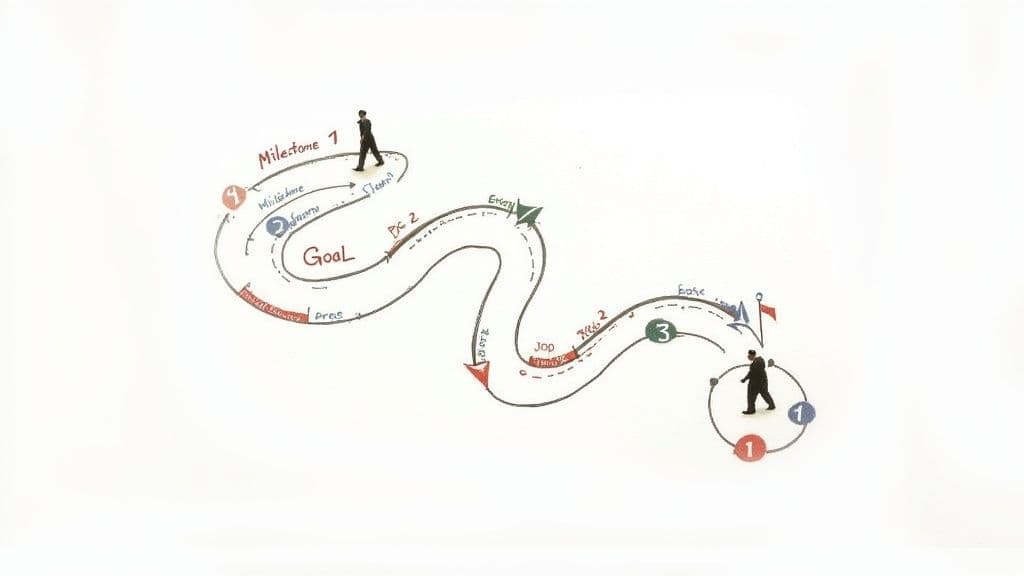
Imagine trying to build a house without any blueprints. You might have the lumber, the nails, and a general idea of what a house looks like, but the process would be a total mess. That's what chasing a big goal without a plan feels like. A goal planner template is the blueprint for your personal and professional life.
The magic behind a goal planner isn't really magic at all—it’s psychology. The simple act of writing down your goals makes you dramatically more likely to achieve them. Studies have shown that when you vividly describe what you want in writing, you're already halfway there.
The Power of Breaking It All Down
At its heart, any good goal planner template is about deconstruction. It forces you to take a huge, intimidating goal—like "start a business" or "run a marathon"—and slice it into smaller, more manageable pieces. This immediately reduces that feeling of being overwhelmed and gives you a clear path forward.
For instance, the massive goal of "start a business" suddenly looks doable when you break it down like this:
- Quarter 1: Complete market research and write the business plan.
- Month 1: Define the target audience and check out the competition.
- Week 1: Create a survey to send to potential customers.
This methodical approach turns a giant ambition into a series of daily and weekly tasks you can actually tackle. Every task you check off is a small win, and those wins build the momentum you need to keep going.
A well-designed goal planner turns ambiguity into action. By providing a framework for your thoughts, it eliminates the mental energy wasted on figuring out "what's next" and allows you to focus purely on execution.
Building Accountability and Seeing Your Progress
Another reason these templates are so effective is they create a natural system of accountability. When your goals have clear deadlines and milestones, you have something real to measure your progress against. That built-in accountability is a huge motivator.
They also give you a visual record of how far you’ve come. Ticking off completed tasks or watching a progress bar inch forward provides a hit of positive reinforcement. This visual feedback is incredibly satisfying and encourages you to stay consistent, making the entire journey feel rewarding.
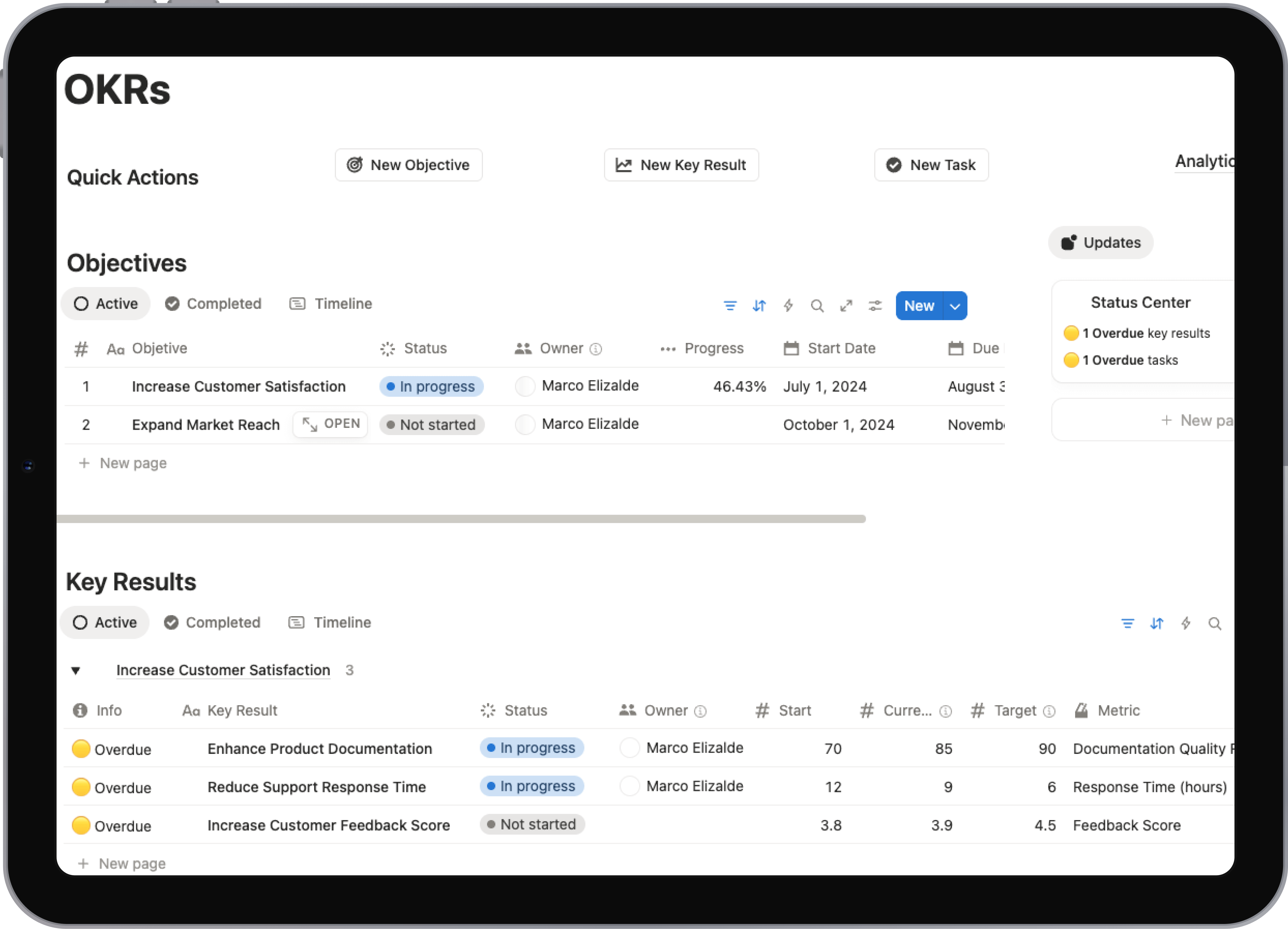
As you map out your strategy, you can explore various Notion productivity templates to find a digital system that fits your specific needs for tracking and visualization. This integration of planning and doing is what truly drives results and makes ambitious goals attainable.
The Anatomy of an Effective Goal Planner
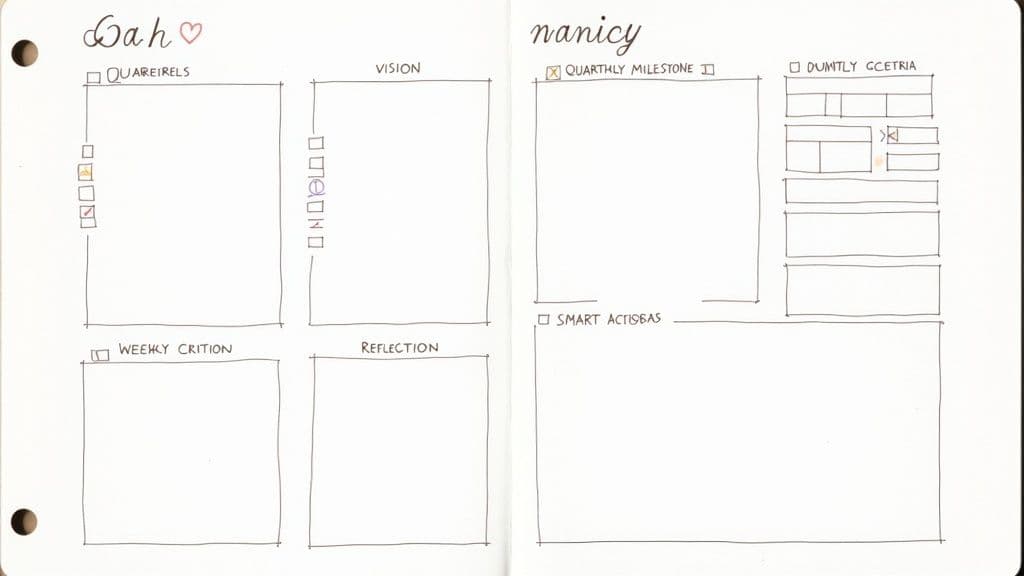 Let’s be honest, not all goal planners are built the same. Some are just glorified notebooks, while others are meticulously designed systems that can genuinely push you forward. The secret sauce is in the structure—the specific, interconnected parts that turn a far-off dream into a series of clear, daily actions.
The best way to think about it is like a cascade. You start at the top with your biggest, most exciting vision. That vision then flows down into smaller and smaller timeframes until it tells you exactly what you need to do today. This top-down approach gives every small task a real sense of purpose, ensuring you're always moving in the right direction.
The Big Picture and Strategic Breakdown
A truly great planner always starts with the end in mind. It gives you a dedicated space to really nail down your long-term vision or your biggest goals for the year. This isn't just about making a to-do list; it's about defining the "why" that will keep you motivated when things get tough.
From that high-level vision, the template starts breaking things down into manageable pieces. It usually looks something like this:
- Quarterly Objectives: These are the major milestones you aim to hit every three months. If your goal is to grow your business, a Q1 objective might be to launch a new company website.
- Monthly Milestones: Now, each quarterly objective gets broken down even further. To get that website live, your Month 1 milestone could be to finalize the design and write all the copy.
- Weekly Action Plans: This is where the rubber meets the road. Your weekly plan lists the specific, tangible tasks you have to complete to hit your monthly milestone. Things like "Write the 'About Us' page" or "Hire a photographer for headshots."
This kind of layered system is a game-changer because it prevents you from feeling overwhelmed. You only ever have to focus on the immediate steps in front of you, all while knowing they're part of a much bigger plan. A planner without this structure is like a map that shows you a destination but forgets to include any of the roads.
Execution and Reflection Elements
Beyond just planning, the most powerful goal planner templates are built for action and learning. A key feature you’ll often find is the SMART goal framework—making sure your goals are Specific, Measurable, Achievable, Relevant, and Time-bound. This simple framework forces you to get crystal clear on what you want, swapping vague wishes for concrete targets.
A great planner is not a passive document you fill out once. It’s an active partner in your growth, prompting you to consistently reflect on your progress, learn from your setbacks, and adjust your strategy.
This is why dedicated spaces for weekly or monthly reflection are so important. This is your chance to look back and ask, "What worked? What didn't? What did I learn?" This constant feedback loop transforms your planner from a simple scheduler into a dynamic tool for self-improvement. It’s that blend of looking ahead and looking back that actually produces results.
The most effective goal planners have several key pieces working together. Here's a quick look at what those are and why they matter.
Essential Components of a High-Impact Goal Planner Template
| Component | Primary Purpose | Key Features |
|---|---|---|
| Vision & Long-Term Goals | To define the ultimate "why" and set the overall direction. | Annual goal-setting pages, vision board space, core values exercise. |
| Quarterly & Monthly Plans | To break down big goals into manageable, time-based milestones. | 90-day focus areas, monthly calendars, milestone tracking. |
| Weekly & Daily Schedules | To translate milestones into specific, actionable tasks. | Prioritized task lists, time-blocking sections, daily habit trackers. |
| Goal-Setting Frameworks | To ensure clarity, focus, and measurability for each goal. | SMART goal worksheets, OKR (Objectives and Key Results) templates. |
| Progress & Habit Trackers | To provide visual feedback and build positive momentum. | Checkboxes, progress bars, calendars for tracking streaks. |
| Reflection & Review | To learn from experience and adjust the strategy for the future. | Guided weekly/monthly review questions, "wins" and "lessons" sections. |
Having these components in place gives you a complete system, not just a list of tasks.
The market is clearly shifting toward templates that offer this kind of robust structure but with digital convenience. In fact, recent industry analyses show that undated, hybrid, and niche-specific planners now make up around 65% of the flexible-planning market. People want adaptable tools that feel organized and give them clear ways to measure their progress, which you can see in the goal-setting templates used in platforms like monday.com.
This kind of structured planning also helps build other positive routines. Many people link their goal planners to other specialized tools. You can see a great example of this by learning how to build a Notion habit tracker template. Once you understand these core components, you’ll be able to spot a truly effective template from a mile away and pick one that will actually help you achieve your biggest ambitions.
Choosing the Right Goal Planner Template for You
<iframe width="100%" style="aspect-ratio: 16 / 9;" src="https://www.youtube.com/embed/w8UDQChR3jQ" frameborder="0" allow="autoplay; encrypted-media" allowfullscreen></iframe>With what feels like an endless sea of goal planner templates out there, just picking one can feel like a goal in itself. It's easy to get drawn in by a beautifully designed planner, but if it doesn't actually fit your personal style and workflow, it's pretty much useless.
The secret is to find a system that feels less like a chore and more like a natural extension of how you already think.
Think about it this way: a marathon runner and a weightlifter are both chasing fitness goals, but their training plans couldn't be more different. Your ideal planner works the same way. It all depends on what you’re chasing and your unique personality. A creative entrepreneur brainstorming a new product needs a completely different setup than an engineer managing a complex project with rigid deadlines.
Finding the best planner for goal setting is about finding a personal coach and strategic partner, all rolled into one.
What’s Your Planning Personality?
Before you even think about downloading or buying a template, take a moment to look inward. Seriously. Understanding your own natural tendencies is the single best thing you can do to find a planner you’ll actually stick with for more than a couple of weeks.
Most of us fall into a few common categories when it comes to planning. See which one of these sounds most like you:
-
The Visual Strategist: You're a fan of mind maps, flowcharts, and color-coding everything. You need a planner with tons of open space to brainstorm, doodle, and connect ideas in a way that makes sense to you.
-
The Minimalist Executor: For you, it's all about simplicity and focus. A clean, uncluttered layout with a clear list of priorities is your happy place. Too many bells and whistles just feel like distracting noise.
-
The Data-Driven Analyst: You're motivated by seeing the numbers go up. Tracking metrics, watching percentages climb, and analyzing your performance is what keeps you going. Look for templates with built-in progress bars and dashboards.
-
The All-in-One Organizer: Your work life and personal life are completely intertwined. You need a powerful system that can handle business projects, doctor's appointments, and wellness goals all under one roof.
Don't ever try to force yourself into a system that feels clunky or unnatural. The whole point is to find a template that makes things easier, not one that adds another layer of tasks to manage. Your planner should work for you, not the other way around.
Match the Template to Your Goals
Once you've got a handle on your personal style, the next step is to look at the goals themselves. A one-size-fits-all approach is a recipe for failure because different kinds of goals demand totally different structures.
Here’s a quick guide to pairing your template with your ambitions:
-
For Complex Projects: If you're managing something big like a business launch, look for goal planner templates built with project management in mind. They often have features like Gantt charts or milestone trackers to help you juggle all the moving parts.
-
For Habit Formation: Is your goal centered on personal growth, like hitting the gym every day or reading more books? A template with a really solid habit tracker is non-negotiable. The best ones give you that satisfying visual feedback when you maintain a streak.
-
For Financial Goals: Saving up for a down payment or getting out of debt requires a laser focus on the numbers. Financial goal planners often come with budget trackers, savings calculators, and debt-snowball worksheets to keep you on track.
-
For Creative Pursuits: If you’re trying to write a book or start a new art series, you need flexibility more than anything. Hunt for templates with lots of blank space, brainstorming pages, and a less rigid daily structure that won't stifle your creative flow.
By first understanding your personality and then the specific needs of your goals, you can confidently pick a template that will actually support your journey instead of just getting in the way.
Comparing Popular Goal Planning Systems
Picking a goal planner template is only half the job. The other, arguably more important half, is choosing the philosophy that drives it. Different goal-setting systems come with their own unique flavors, and finding the right one is like picking the right operating system for your ambitions—it will define how you process tasks and bring your plans to life.
Think of it this way: some people work best with a super-structured, rule-based system, while others need the freedom to zig and zag. There's no single "best" method. There's only the one that clicks with how your brain works and what you're trying to achieve. Let's look at a few popular ones to see which might feel most natural to you.
The Structured vs. The Flexible
At one end of the spectrum, you've got highly organized systems like the Franklin Covey method. This approach is all about prioritizing tasks using a time-tested matrix of urgency and importance. It's perfect for professionals juggling complex schedules who need a logical way to decide where to focus their energy first. You can think of it as a detailed, turn-by-turn GPS for your productivity.
On the complete opposite end is the Bullet Journal (BuJo) method. This system is famous for its incredible flexibility. You start with a blank notebook and a simple set of symbols, giving you the power to create a totally custom planner. It can be a task manager, a diary, a sketchbook, and more—all in one. This is a dream for visual thinkers and creative types who feel boxed in by rigid planners.
The best goal-setting system isn't the one with the most bells and whistles. It's the one you'll actually stick with. Your aim is to find a method that makes things easier, not one that adds another complicated task to your to-do list.
The Corporate and Team-Focused Approach
When your goals involve more than just you, you need a different kind of framework. For businesses and teams, Objectives and Key Results (OKRs) have become the gold standard for setting big, measurable goals. This system is brilliant at connecting the company's main objectives with what each individual is working on, creating alignment and making sure everyone is on the same page.
If you're exploring frameworks for a team, OKRs are a powerful way to get everyone aligned. You can even use an OKR generator to help you get started. The structure is refreshingly simple:
- Objective: What do you want to achieve? This should be ambitious and inspiring. (e.g., "Become the go-to resource in our industry.")
- Key Results: How will you measure your progress? These need to be specific and measurable. (e.g., "Increase organic traffic by 30%" or "Publish 15 in-depth articles.")
This method is fantastic for data-driven people and organizations that need to turn a grand vision into a set of clear, trackable metrics.
Comparison of Popular Goal Planning Methodologies
To make the choice a little easier, here’s a quick breakdown of some of the most common goal-setting systems. Think about your own work style and what you want to accomplish as you review them.
| Methodology | Best For | Key Strengths | Potential Drawbacks |
|---|---|---|---|
| OKRs | Teams, businesses, and data-driven individuals | Aligns team efforts with company goals; highly measurable and transparent. | Can be too complex for simple personal goals; requires regular check-ins. |
| SMART Goals | Individuals and professionals seeking clarity | Simple, clear, and provides a concrete checklist for goal creation. | Lacks a big-picture vision; can feel a bit clinical or uninspiring. |
| Bullet Journal (BuJo) | Creative thinkers and people who want total control | Infinitely customizable and flexible; combines planning with journaling. | Requires initial setup and consistent effort to maintain; can become messy. |
| Franklin Covey | Busy professionals managing many priorities | Excellent for time management and prioritizing tasks based on importance. | Can feel rigid and overly structured for those who prefer flexibility. |
Ultimately, understanding these core systems will help you spot which goal planner templates are built to support your unique way of getting things done. Choose the framework that feels less like a chore and more like a natural extension of how you already think.
Customizing Your Digital Planner in Notion
While a physical planner provides a rigid structure, a digital tool like Notion gives you a completely blank canvas. It's the difference between buying a pre-built house and being the architect yourself—you get to design a goal-planning system that fits your brain perfectly. This is where the real magic of digital goal planner templates shines: their near-infinite capacity for customization.
You can take a basic template and evolve it into a powerful, interconnected dashboard that runs your entire life. The key is to move past simple to-do lists and start building a system of linked databases for your big-picture goals, the projects that support them, and the daily tasks that push everything forward.
Building Your Core System with Databases
The heart of any truly effective Notion planner is a set of interconnected databases. Now, "databases" might sound intimidating, but it's simpler than you think. Just imagine you have three digital filing cabinets: one for your "Annual Goals," one for your "Projects," and one for your "Daily Tasks."
The real power kicks in when you start linking them. For instance, you can tie every entry in your "Projects" database back to a specific "Annual Goal." That one simple link ensures that every single project you’re working on is actively pushing you toward one of your big-picture ambitions.
Then, you can connect your "Daily Tasks" to their respective "Projects." Suddenly, when you sit down to plan your day, every task on your list has a direct line of sight all the way up to your ultimate goals. This creates an incredible sense of purpose and clarity. If you want to get granular on structuring your day-to-day, check out how a dedicated Notion daily planner can be set up.
A customized Notion planner isn't just a place to write down goals; it's a living system that visualizes the connections between your daily actions and your long-term vision. It turns abstract ambitions into a clear, interactive roadmap.
Automating Progress and Tracking Habits
Once your databases are connected, you can start using some of Notion's more advanced features to make your planner work for you. This is where a digital system leaves a static, paper planner in the dust.
Here are a few powerful customizations to try:
- Automated Progress Bars: Using Notion’s "Rollup" and "Formula" properties, you can create progress bars for each of your annual goals. These bars will automatically update based on how many related projects you’ve completed, giving you a real-time visual of how far you’ve come.
- Dynamic Habit Trackers: Set up a separate database just for your daily habits. With a few simple relations and formulas, you can track your streaks and watch your consistency percentage update live on your main dashboard.
- A Weekly Review Dashboard: Create a dedicated page that automatically pulls in all your completed tasks and progress from the past 7 days. This turns your weekly reflection from a chore into an efficient, data-driven review.
The diagram below shows a few different planning philosophies. Think of them as inspiration for the kind of system you can build for yourself inside Notion.
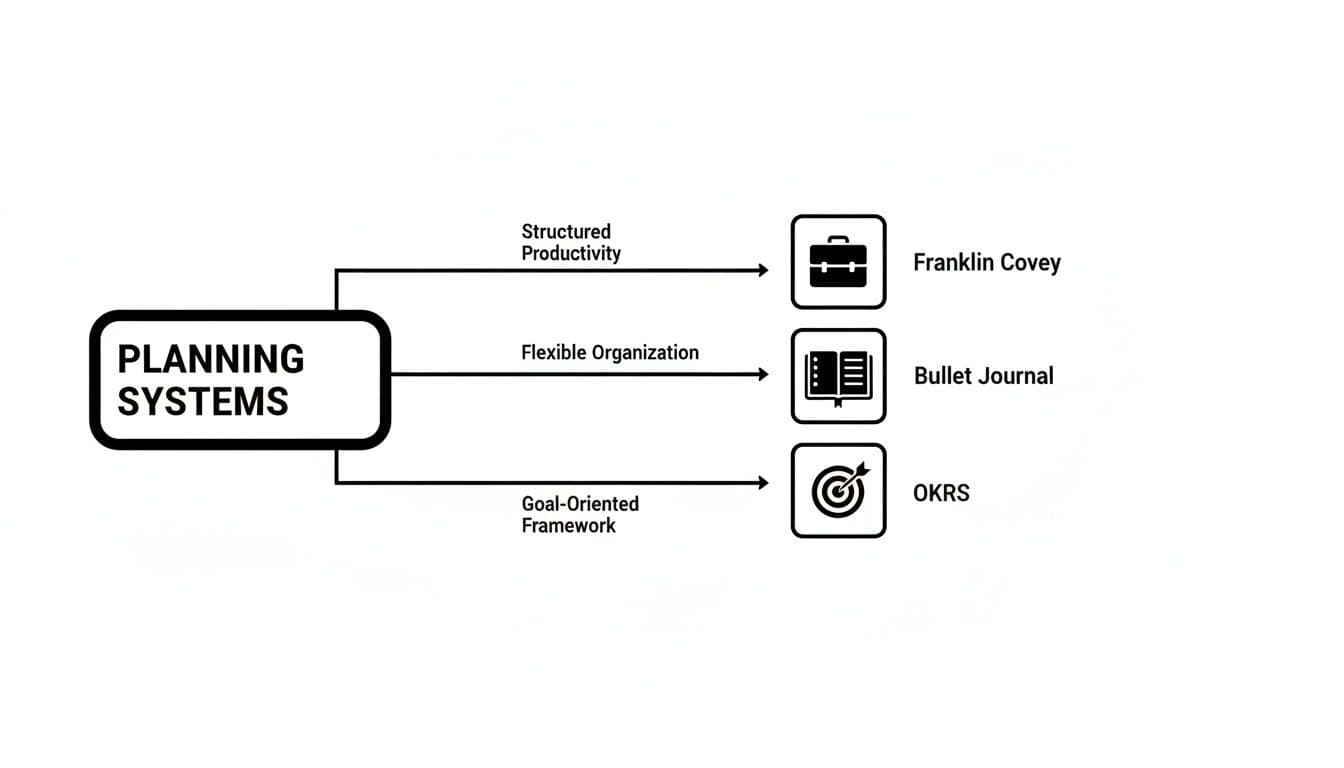
This just goes to show, whether you love the rigid structure of a Franklin Covey system or the freeform nature of a Bullet Journal, Notion has the flexibility to replicate the best parts of any method. When you build a digital planner this way, you’re not just tracking your ambitions—you're creating a tool that actively helps you achieve them.
Common Questions About Goal Planner Templates
Even when you've found the perfect goal planner template, a few questions always seem to pop up once you start putting it to use. It's completely normal. Let's walk through some of the most common ones so you can feel confident turning your plans into reality.
One of the first things people ask is how often they should actually look at their planner. The secret isn't about staring at it for hours every day; it's about building a simple, consistent rhythm of checking in.
Your goal planner isn't a rigid contract you've signed with yourself. Think of it as a living, breathing guide that’s meant to be tweaked, reviewed, and learned from. Falling behind isn’t a failure—it’s just feedback.
This approach helps you stay connected to your big-picture vision without getting bogged down in the daily details. Each check-in serves a different purpose, linking what you do today to where you want to be tomorrow.
How Often Should I Review My Plan?
When it comes to reviewing your goals, consistency beats intensity every time. One frantic, two-hour planning session at the start of the month is far less effective than a few quick, regular check-ins.
Here’s a simple schedule that works wonders:
- Daily Check-in (5-10 minutes): First thing in the morning, take a quick peek at your top priorities for the day. This simple habit keeps your most important tasks right in front of you.
- Weekly Review (30-60 minutes): Set aside a bit of time to look back at the past week. Celebrate what you accomplished, figure out what got pushed aside, and lay out a clear plan for the week ahead.
- Monthly or Quarterly Review (1-2 hours): This is your chance to zoom out. Are you still making good progress on your bigger milestones? Do you need to adjust your goals based on new information or opportunities?
This rhythm transforms your planner from a static to-do list into an active partner in achieving your ambitions.
What Should I Do If I Fall Behind?
Look, it's not a matter of if you'll fall behind, but when. Life happens. Unexpected things come up, and even the most perfectly crafted plans can get thrown off course. The most important thing is not to get discouraged and abandon your planner completely.
Instead, see it as a chance to learn. Ask yourself what happened. Was your timeline a little too optimistic from the start? Did other priorities suddenly demand your attention? A study on goal achievement found that people who wrote down their goals and shared their progress were 76% more likely to succeed. This shows just how powerful having a structured plan can be, even when you have to adjust it.
So, don't give up. Just adjust. Break that overwhelming task into even smaller, more manageable steps. Push a deadline back a week. The aim here is progress, not perfection.
At Flowtion, we design battle-tested Notion templates that turn your goals into achievements. Skip the setup and get a powerful, ready-to-use system with just one click. Explore our templates today at https://theflowtion.com.