---
title: Work and Time Guide: Essential Concepts and Tips 2025
description: Master work and time with essential concepts, formulas, and expert tips for 2025. Boost your problem-solving skills and ace exams or real-world tasks today..
author: Marco Elizalde
published: 2025-02-4
category: Notion Templates
tags: Notion, Templates
reading_time: 7 min
canonical: https://theflowtion.com/blog/work-and-time
---
# Work and Time Guide: Essential Concepts and Tips 2025
Mastering work and time is the secret behind productivity, efficiency, and exam success in 2025. Whether you’re a student preparing for competitive exams or a professional juggling deadlines, understanding work and time gives you a powerful edge.
This guide unpacks the essential concepts, must-know formulas, and expert strategies to help you tackle any work and time problem—both in tests and real-world scenarios.
Inside, you’ll discover core definitions, practical techniques, common problem types, real-life applications, and step-by-step methods to solve even the toughest questions. Ready to boost your confidence and results? Dive in and transform your approach to work and time today.
## Understanding Work and Time: Definitions, Key Terms, and Core Concepts
Unlocking the secrets of work and time is essential for anyone aiming to boost productivity, ace exams, or manage projects. Let’s break down the foundational ideas, terms, and relationships that power every work and time problem—whether in a textbook or real life.
### What Is Work and Time?
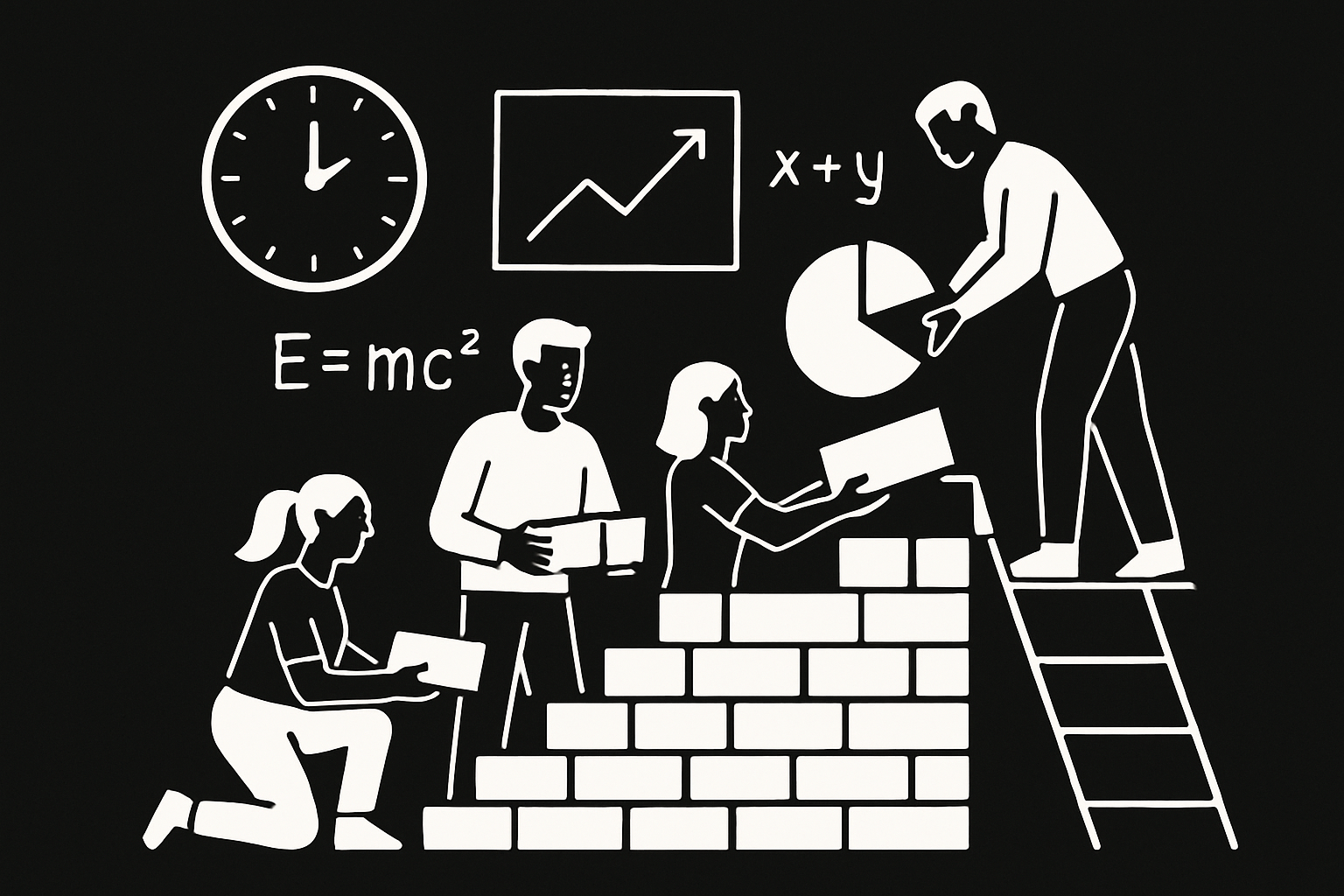
Work and time is a core concept in quantitative aptitude and everyday situations. In simple terms, "work" refers to a specific task or amount of output, while "time" is the duration needed to complete that work. These two elements are closely linked by "efficiency"—how quickly or effectively someone can finish the task.
For example, imagine building a wall, completing a project, or even filling a water tank. The work and time needed depend on the resources and speed of the people involved. Mastering these ideas is vital for exams like SSC or Banking, as well as for effective project planning and time management in daily routines.
### Essential Terms and Units
Understanding work and time starts with mastering a few key terms. "Work" is the total task to be finished. "Time taken" is the number of days or hours required. The "rate of work" is how much of the task is done per unit of time, and "efficiency" measures how quickly work is completed. Sometimes, you’ll encounter "negative work," where something undoes the progress (like a leak in a tank).
Units such as "man-days" or "man-hours" help quantify work and time, especially when teams are involved. For instance, if a job takes 10 days, then one day’s work equals 1/10 of the task. Imagine dividing household chores among family members—understanding these units ensures everyone shares the load fairly and calculations stay accurate.
### Relationship Between Work, Time, and Efficiency
The relationship between work and time is rooted in simple math:
- Work = Rate × Time
- Rate = 1 / Time
Efficiency and time are inversely proportional—the more efficient you are, the less time you need. For example, if worker A is twice as efficient as B, A will complete the job in half the time B would take. Changing the number of workers or hours directly affects how quickly the work and time balance out.
These principles form the backbone of most exam questions. For a deeper dive into formulas and example problems, check out [Time and Work Formula, Concept & Aptitude Questions for Bank Exams](https://www.bankersadda.com/time-and-work-for-bank-exams/), which breaks down key concepts and application techniques.
### Work Equivalence and Negative Work
Work equivalence helps you compare teams, days, and tasks using the formula: M1D1T1 = M2D2T2. Here, M stands for workers, D for days, and T for hours. This formula lets you adjust calculations when groups or hours change.
Negative work occurs when something actively undoes progress, like a leak in a cistern or a worker causing delays. For example, if extra workers join or leave a project mid-way, the work and time calculations must adjust accordingly. Mastering these advanced ideas is crucial for tackling complex problems and real-world challenges.
## Fundamental Formulas and Calculation Techniques
Mastering the essential formulas and calculation techniques is the cornerstone of solving any work and time problem efficiently. Whether you’re aiming for exam success or streamlining real-life projects, these foundational tools will boost your confidence and accuracy.
### Core Formulas for Work and Time Problems
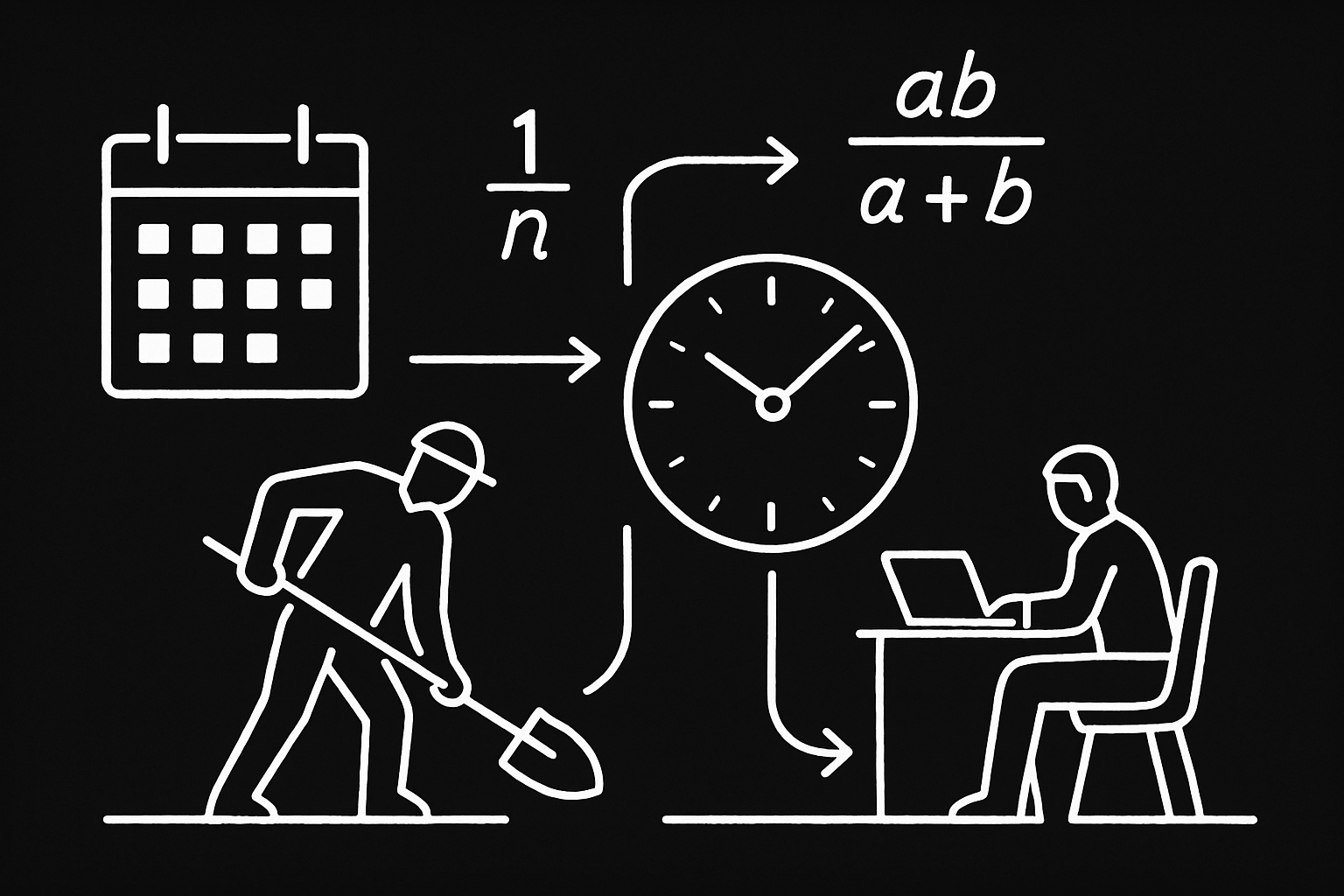
The backbone of work and time questions lies in a handful of straightforward yet powerful formulas. These equations help you break down complex scenarios into manageable steps.
Here's a quick summary table:
| Concept | Formula |
| -------------- | ---------------------------- |
| Work Done | Time Taken × Rate of Work |
| Rate of Work | 1 / Time Taken |
| Time Taken | 1 / Rate of Work |
| One day’s work | 1 / n (n = days to complete) |
For example, if A can finish a task in 10 days, A’s one day’s work is `1/10`. In every work and time problem, remember that efficiency and time are inversely proportional. The faster you work, the less time it takes!
### Ratio and Proportion Applications
Many work and time problems hinge on comparing efficiency or time between individuals or groups. Ratios make these comparisons simple and quick.
Suppose you need to adjust calculations when the team changes — maybe 12 men can do the same work as 18 boys. If the group composition shifts, use ratios to find the new time or work done.
For instance, if the ratio of men to boys is 2:3, and the original team completes the work in 6 days, you can recalculate completion time for a different group using the same ratio principles. Over 60% of exam questions use these ratio-based work and time scenarios.
### Work Equivalence Formula in Depth
When you face problems involving varying workers, days, or even different quantities of work, the work equivalence formula is your go-to tool:
```
M1 × D1 × T1 × W2 = M2 × D2 × T2 × W1
```
Where:
- M = number of workers
- D = number of days
- T = hours per day
- W = amount of work
Let’s say 20 people make 20 toys in 15 days. To find out how many days 25 people need to make 30 toys, plug the values into the formula and solve for the unknown. This approach is essential for advanced work and time problems in factories, construction sites, and large projects. For a deeper dive into formulas and examples, check out [Time and Work Formulae | Learn and Solve Questions](https://www.vedantu.com/formula/time-and-work).
### Special Cases: Negative Work and Combined Work
Not all work and time challenges are about building or creating—sometimes, you’ll encounter negative work, like leaks in a tank or someone undoing progress. In these cases, subtract the rate of negative work from the positive.
For example, if a tap fills a tank in 6 hours and a leak empties it in 8 hours, the combined work rate is:
`1/6 - 1/8 = 1/24`
So, the tank will be filled in 24 hours with both tap and leak working together.
Combined work problems also pop up frequently, requiring you to add or subtract rates depending on the scenario. Recognizing these special cases is crucial for mastering work and time calculations, especially in exams or real-world troubleshooting.
## Types of Work and Time Problems: Patterns and Real-World Scenarios
Understanding the different types of work and time problems is essential for mastering this topic—both in competitive exams and in real-world project management. Each pattern tests a unique aspect of your ability to analyze efficiency, manage resources, and solve practical challenges.
### Individual vs. Group Efficiency Problems
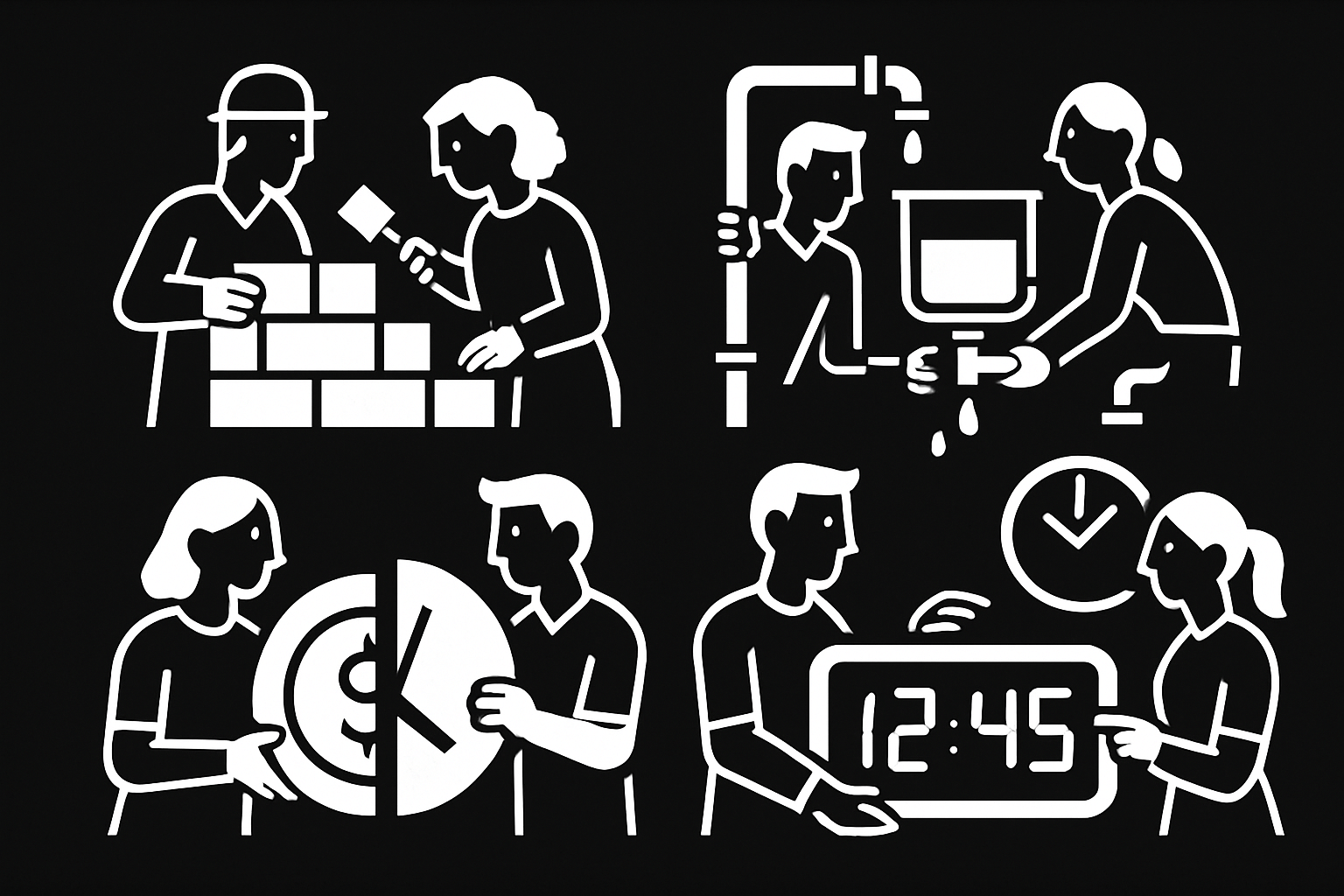
Many work and time questions start with comparing how fast individuals or groups can complete a task. For example, if A can finish a job in 10 days and B in 15, working together, they complete it faster. The key is to calculate each person's one-day work and then combine them.
- **Formula:** One day’s work = 1/number of days.
- **Combined work:** Add one-day work rates for all workers.
- **Example:** A (1/10) + B (1/15) = (1/6) of the work per day; together, they finish in 6 days.
This type of work and time problem is common in exams and mirrors real-life team projects, where collaboration boosts efficiency.
### Successive and Alternating Work Patterns
Some work and time scenarios involve workers joining, leaving, or alternating shifts. These problems require tracking who works when and for how long. For instance, P works alone for a day, then Q and R join every third day, changing the overall rate.
- **Stepwise approach:** Break down the timeline into intervals.
- **Track work done each interval:** Use a table for clarity.
- **Example:** Calculate total work completed after each cycle.
If you want to see more examples and practice different patterns, check out this [Time and Work - Aptitude Questions and Answers](https://www.geeksforgeeks.org/ssc-banking/time-and-work/) resource for a variety of real exam-style questions.
### Work and Wages Problems
Work and time problems often link directly to wages, especially when payment must be split among workers based on their contribution. The rule: Wages are proportional to efficiency.
- **Ratio of wages = ratio of efficiency.**
- **Example:** If Ankit, Bishal, and Dinesh complete a project for Rs. 4800, and Ankit is twice as efficient as Bishal, split the payment accordingly.
This pattern is practical for dividing earnings in freelance projects or group contracts, where fair payment depends on each person’s work and time invested.
### Real-Life Scenarios: Pipes, Leaks, and Group Tasks
Many advanced work and time problems use real-world analogies like pipes filling tanks, leaks causing negative work, or teams with changing members. These scenarios require combining positive and negative work rates.
- **Pipes/cisterns:** Filling vs. leaking rates.
- **Group tasks:** Members join or leave partway.
- **Example:** A tap fills a tank in 6 hours; a leak empties it in 8. Calculate the net rate to find the total time required.
These practical problems make up over 30% of exam questions and test your ability to apply work and time logic beyond simple math.
## Step-by-Step Guide: Solving Work and Time Problems Effectively
Tackling work and time problems can feel daunting, but with a systematic approach, anyone can master them. By breaking down each scenario, applying the right formulas, and checking your calculations, you’ll steadily build confidence and accuracy. Let’s walk through a proven step-by-step method to solve work and time challenges—perfect for exams and real-life scenarios alike.

### Chronological Approach to Problem Solving
Start every work and time problem by carefully reading the question. Identify what’s being asked—is it about total time, efficiency, amount of work done, or payment distribution? Jot down all given data points and underline keywords like “together,” “alone,” “leak,” or “rate.”
Next, list out known formulas that might apply. Assign variables to unknowns, such as days (D), workers (M), or rate (R). This clarity saves time and reduces errors. By maintaining a stepwise mindset, you set the foundation for accurate and efficient problem-solving in any work and time context.
### Breaking Down the Problem: Units and One-Day Work
Consistency in units is crucial for solving work and time puzzles. Convert everything to the same unit—days, hours, or workers—before proceeding. For example, if a task mixes hours and days, convert hours to days or vice versa.
Calculate “one day’s work” by dividing the total work into daily segments. For instance, if a person completes a job in 15 days, their one day’s work is `1/15`. This concept makes it easier to sum up contributions from multiple workers and helps visualize progress, both in exams and project management.
### Applying the Right Formula or Approach
Identify the type of work and time problem you’re facing: Is it an individual effort, a group task, an alternating pattern, or a scenario involving negative work like leaks? Choose the matching formula, such as `ab/(a+b)` for two workers or `Work = Rate × Time` for basic calculations.
For combined efforts, sum up the individual one day’s work rates to get the group’s daily output. This method is particularly useful when dealing with pipes filling a tank or teams working together. Matching the right approach to the problem type ensures you don’t waste time on unnecessary calculations.
### Solving for Unknowns: Stepwise Calculation
Once you’ve set up your equations for the work and time scenario, solve for the unknowns systematically. Write each step clearly, keeping track of variables and units. For example, to find the number of workers needed, use the formula: `Workers = Total Work / (Efficiency × Days)`.
Check your logic as you go. If the problem involves a group leaving or joining midway, recalculate for the remaining work. This stepwise calculation process helps avoid confusion and ensures you reach the correct answer every time you tackle a work and time problem.
### Verification and Checking for Errors
Always double-check your calculations. Review arithmetic, ensure units match, and verify that your answer makes sense in the context of the work and time question. Use estimation to quickly assess if your result is reasonable—if it seems too fast or too slow, revisit your steps.
Cross-verify with an alternative method if possible. Plug your answer back into the original formula to confirm it fits. This habit not only sharpens your accuracy but also boosts your confidence during exams or when managing real-world tasks involving work and time.
### Practice with Sample Problems
Practice cements your understanding of work and time concepts. Try solving problems like: “A and B together finish a job in 12 days. A alone does it in 20 days. How long for B alone?”
**Solution:**
- A’s one day’s work = 1/20
- A + B’s one day’s work = 1/12
- B’s one day’s work = 1/12 - 1/20 = 1/30
- So, B alone takes 30 days.
## Advanced Tips, Tricks, and Common Mistakes to Avoid
Unlocking the secrets of work and time mastery means going beyond formulas. To gain a real edge—whether you're aiming for exam excellence or workplace efficiency—you need smart shortcuts, practical insights, and a keen eye for common traps.
### Efficiency Shortcuts and Time-Saving Techniques
Speed is essential in both exams and real-world work and time situations. Memorizing key formulas—like `ab/(a+b)` for two-worker problems—can save precious seconds. The LCM method is another favorite for quickly finding common work periods.
- **Prioritize**: Focus on the most common question types.
- **Visualize**: Sketch quick diagrams to map out work distribution.
- **Estimate**: Use approximation for faster elimination of wrong choices.
For those seeking to level up their efficiency, explore [Productivity strategies for professionals](https://theflowtion.com/productivity)—these methods complement work and time problem-solving in both study and career settings.
### Handling Complex Group and Alternating Scenarios
Many work and time questions involve teams that change over time or alternate tasks. Break these problems into smaller chunks—track each worker’s daily contribution with a simple table or chart.
| Day | Worker(s) Active | Work Done |
| --- | ---------------- | --------- |
| 1 | A+B | 2/15 |
| 2 | B only | 1/15 |
| 3 | A+B | 2/15 |
This approach helps you visualize progress and prevent mistakes. When group composition shifts, recalculate the combined rate for each interval. Always write down what's happening each step—clarity is key to solving the toughest work and time scenarios.
### Avoiding Common Pitfalls and Calculation Errors
Even seasoned problem-solvers can stumble on work and time traps. The biggest culprits? Unit mismatches, sign errors with negative work, and misreading efficiency ratios. Double-check if your answer makes sense—does it fit the scenario described?
- **Watch units**: Are you working in hours or days?
- **Check efficiency**: "Twice as efficient" means half the time, not double.
- **Negative work**: Leaks and losses must be subtracted, not added.
A quick review after solving can catch small errors that cost big points. Keeping a checklist for common mistakes is a smart habit for every work and time enthusiast.
### Practice and Exam Strategy Insights
Consistent practice is the single most effective way to master work and time. Tackle a variety of problems—individual, group, alternating, and those involving negative work. Time yourself to build speed and accuracy.
- **Analyze trends**: Review past exams for recurring patterns.
- **Set goals**: Allocate a fixed number of minutes per question.
- **Reflect**: After practice, revisit errors to understand why they happened.
For tailored advice, check out [Student time management tips](https://theflowtion.com/students)—these strategies help you apply work and time techniques to both exam prep and daily routines.
## Real-World Applications and Career Relevance in 2025
Mastering work and time isn’t just about passing exams—it’s a powerful toolkit for navigating daily challenges and advancing your career. Whether you’re managing a team, planning an event, or looking to boost your personal productivity, understanding these concepts creates a foundation for smarter, more efficient work.
### Practical Uses of Work and Time Concepts
In the real world, work and time calculations help streamline everything from project management to large-scale construction. Imagine estimating deadlines, allocating resources, or dividing tasks among teams—every scenario relies on these principles.
For example, building a bridge requires careful planning when crew sizes change. Event planners use work and time strategies to assign volunteers, ensuring everything runs on schedule. In manufacturing, managers predict how many workers are needed to meet production targets, optimizing both costs and timelines.
A quick summary of practical applications:
| Field | Application Example |
| ------------------ | ------------------------------------ |
| Project Management | Scheduling, resource allocation |
| Event Planning | Task division among volunteers |
| Construction | Workforce and deadline estimation |
| Manufacturing | Production and staffing optimization |
No matter the field, work and time skills make complex projects achievable.
### Importance in Competitive Exams and Assessments
The work and time topic is a staple in competitive exams like SSC, Banking, and Railway assessments. Typically, you’ll find 2–5 questions per quantitative section dedicated to these problems.
Data shows work and time consistently ranks among the top five quantitative aptitude topics. For instance, exams such as IBPS PO, SSC CGL, and RRB NTPC regularly feature questions involving pipes, group tasks, and efficiency ratios.
Examiners love these problems because they test both analytical thinking and calculation speed. If you’re an aspirant, practicing work and time questions is crucial for boosting your overall score and gaining an edge over the competition.
### Enhancing Productivity and Time Management Skills
Applying work and time principles isn’t limited to academics or the workplace—it’s also a game-changer for personal productivity. Breaking down big goals into daily, manageable tasks mirrors the “one day’s work” approach.
For students, this means creating study plans by dividing the syllabus into achievable chunks. Professionals can set daily targets, track progress, and adjust strategies to stay on course. Leveraging [personal organization and efficiency](https://theflowtion.com/personal) techniques empowers you to make the most of every hour.
The outcome? Improved time management, reduced stress, and a clear path to achieving both short-term and long-term objectives.
### Emerging Trends and Digital Tools for 2025
Looking ahead, the landscape of work and time management is rapidly evolving. AI-powered project management apps and time-tracking software are becoming standard in both corporate and personal settings.
Many productivity platforms now feature built-in calculators and analytics, making it easier to apply work and time formulas instantly. Mastering the basics allows you to get the most from these digital tools. For instance, using [time tracker digital tools](https://theflowtion.com/templates/time-tracker) can help monitor progress, identify bottlenecks, and optimize workflows.
In 2025, those who combine a strong grasp of work and time fundamentals with smart tech will be best equipped to excel in any field.
Now that you’ve got a solid handle on work and time concepts, why not make things even easier for yourself? Whether you’re juggling projects, prepping for exams, or just want to stay on top of your daily goals, a great template can save you tons of time and mental energy. I’ve found that using a smart system helps you turn all these strategies into real results—without any extra hassle. If you want to put these ideas into action right away, you can [get free template](https://theflowtion.com/templates/time-tracker) and start tracking your time like a pro.